It is evident that appliances make life so easy since they enable us to store food, do laundry and washing dishes. Nevertheless, despite being durable and efficient, there comes a time when we need to fix them and maintain them. Knowledge on how to fix and maintain an appliance and when it should be repaired or replaced may save you hundreds of dollars a year.
Home Appliance Repair and
Maintenance Manual (2026) will provide you with information on the maintenance process and all problems related to household appliances including whether to repair or change the appliance and other things.
Why is Maintenance of Appliances Necessary?
Homeowners tend to call professionals only when their appliance malfunctions completely.
Regular
home appliance maintenance gives you such benefits as:
- Increased appliance durability
- Fewer costs on repairs
- Better energy efficiency
- No surprise breakdowns
- Safety of your home
Maintaining the appliance performance according to manufacturer specifications
Maintenance is always cheaper than appliance repair.
Life Span of Key Household Appliances
Knowing the life span of your appliances will make it easier for you to choose whether to repair an appliance. In addition, proper maintenance can often add several years to these estimates.
| Refrigerator |
10–15 Years |
| Dishwasher |
8–12 Years |
| Washing Machine |
10–15 Years |
| Dryer |
10–13 Years |
| Oven & Range |
13–18 Years |
| Microwave |
7–10 Years |
| Garbage Disposal |
8–15 Years |
| Freezer |
12–16 Years |
Overall, proper maintenance can often add several years to these estimates.
Common Appliance Problems and Solutions
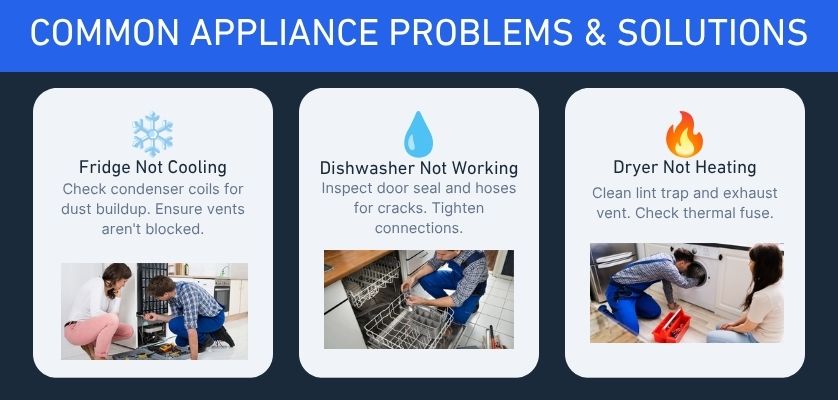
Not Cooled Refrigerator
A frequently seen problem with refrigerator repairing is the case of a warm refrigerator and cold freezer.
Causes
- First, accumulation of dirt in the condenser coils.
- Additionally, obstruction in the air vents.
- In some cases, problematic evaporator fan.
- Moreover, defrost system malfunctions.
- Finally, broken compressor.
Maintenance
- First, clean condenser coils every six months.
- Next, clear air vents.
- Also, test door seals.
- Finally, maintain the temperature of 37–40 °F.
As a result, regular maintenance helps prevent costly refrigerator repairs.
Washing Machine Problems
Washing machines have high utilization and wear out. Therefore, routine maintenance is essential.
Common Trouble Spots
- Won’t spin
- Won’t drain
- Water leaking
- Too much vibration
- Foul odors
Maintenance Tips
- First, do not overload.
- Next, perform monthly cleaning of the drain filter.
- Also, keep the door open after each cycle.
- Finally, use correct detergent.
Consequently, regular washing machine maintenance avoids costly repairs.
Dryer Doesn’t Heat
One of the most frequently searched appliance repair troubles is a dryer that runs but does not heat. However, this issue is often caused by a few common problems that can be identified early.
Reasons
- First, failure of the heating element.
- Additionally, fused thermal switch.
- Moreover, obstruction of the dryer vent.
- Finally, thermostat defect.
Maintenance Tips
- After each load, clean the lint trap.
- In addition, clean the dryer vents once per year.
- Finally, avoid overfilling the drum.
As a result, cleaned dryer vents help improve performance and prevent fire hazards.
Dishwasher Troubles
Dishwashers become prone to drainage and cleaning troubles.
Symptoms
- Water standing
- Unwashed dishes
- Foul smell
- Water leaking
Prevention
- Weekly filter cleaning.
- Once per month use dishwasher cleaning.
- Clean scraped dishes before loading.
- Periodically check the spray arms.
Oven/Stove Trouble Spots
Kitchen appliances need regular maintenance as well.
Trouble Spots
- Doesn’t heat
- Baking unevenly
- Burners won’t light
- Temperature readings incorrect
Maintenance Tips
- Clean up spills right away.
- Replace faulty burner igniters.
- Temperature calibration once a year.
Indicators That Your Appliance Is Needing Repair
Many appliances give off signals before they break down altogether.
Look out for:
- Screaming noises
- Odors of burning
- Leaking water
- High electricity bills
- Cycling too often
- Working slowly
- Indicating error codes
- Spoiled food
- Clothes not drying
- Ineffective cleaning cycles
Ignoring these signs can lead to bigger repair bills.
Appliance DIY Troubleshooting Guide
Before you call an appliance repair service, try these simple troubleshooting steps.
Check the Power Source
- First, inspect the electrical outlet.
- Next, examine the circuit breaker.
- Also, inspect the power cord.
Check the Airflow
- Finally, clean the air vents.
- In addition, remove any obstructions.
- If necessary, inspect and clean the filters.
Or, if you prefer a bullet-list style:
Check the Power Source
- Inspect the electrical outlet.
- Examine the circuit breaker.
- Look for damage to the power cord.
Check the Airflow
- Clean the air vents.
- Remove any obstructions.
- Inspect and clean the filters.
Choose Repair When:
- Your appliance is less than 8 years old.
- The repair costs less than half the price of a new one.
- Replacement parts are easy to find.
- Your appliance still works well.
- Only a small part needs to be fixed.
Choose Replacement When:
- Your appliance is older than its expected life.
- The compressor or motor has failed.
- It needs repairs many times each year.
- Your energy bills keep getting higher.
- The repair costs more than buying a new appliance.
A trusted appliance repair expert can help you choose the best option.
An experienced appliance repair service will guide you in making your choice.
Annual Appliance Maintenance Checklist
Using a seasonal maintenance schedule helps keep your appliances in excellent condition throughout the year.
Spring
- First, clean your refrigerator’s coils.
- Next, inspect your washing machine’s hoses.
- Also, inspect the vent of your dryer.
- Finally, clean your dishwasher filter.
Summer
- During summer, inspect the refrigeration function of your fridge.
- In addition, clean the freezer coils.
- Then, inspect the ventilation function.
Fall
- As the weather changes, clean your oven.
- Next, inspect your smoke detectors near appliances.
- Also, inspect your electrical cords.
Winter
- Before winter, inspect your door seals.
- Additionally, avoid freezing of your water lines.
- Finally, do preventative maintenance of your appliances.
Overall, using an annual checklist will help prevent emergencies.
How to Extend Appliance Lifespan
Simple things matter greatly. For example:
Refrigerator
- Avoid packing up shelves.
- Also, service coils biannually.
- If needed, replace faulty door seals.
Washing Machine
- Load clothes evenly.
- In addition, use HE soap.
- Furthermore, clean the tub each month.
Dryer
- Clean the lint filter after each cycle.
- Additionally, check ventilation every year.
Dishwasher
- Clean spray arms.
- Also, use rinse additive.
- Finally, remove food bits.
Oven
- Avoid harsh chemicals.
- Instead, clean spills instantly.
- If necessary, replace broken seals.
Advantages of Professional Appliance Repairs
While DIY maintenance is helpful, professionals have many benefits.
Professional appliance repairs offer:
- Correct diagnosis
- Authentic replacement parts
- Protection under warranty
- Safe electrical repairs
- Increased appliance lifespan
- Better efficiency
Furthermore, hiring an expert appliance repair company will save you from the extra harm done by incorrect appliance repairs.
How to Select a Proper Appliance Repair Company
Not all repair companies have the same expertise level. Therefore, choosing the right service provider is important.
What should you look for?
- First, licensed specialists
- Next, same day service
- In addition, good reviews of customers
- Also, warranty for repairs
- Furthermore, experience with popular brands
- Moreover, reasonable prices
- Finally, emergency repairs
As a result, selecting a good local appliance repair company will ensure your safety.
Appliance Maintenance Mistakes Most People Neglect
The majority of malfunctions occur simply because basic maintenance procedures are neglected. Therefore, remember to:
- First, vacuum the refrigerator coils twice per year.
- Next, change any broken water supply lines.
- Also, wash the washing machine filters on a monthly basis.
- In addition, take out the lint buildup around the dryer.
- Furthermore, check the appliance cords for damages.
- Moreover, keep the appliances at the correct level.
- If necessary, change any damaged door seals.
- Finally, schedule an annual maintenance visit by a professional.
In the long run, all these steps will help you minimize your appliance repair costs.
The majority of malfunctions occur simply because basic maintenance procedures are neglected.
Remember to:
- Clean the refrigerator coils twice a year.
- Replace broken water lines.
- Clean the washing machine filter every month.
- Remove lint from the dryer.
- Check power cords for damage.
- Keep appliances level.
- Replace worn door seals.
- Get a professional inspection once a year.
These steps are easy to follow. As a result, they help prevent breakdowns. You can also lower repair costs. In addition, your appliances will last longer.
Conclusion
Appliances are expensive purchases, and therefore proper appliance care is crucial. Regular maintenance and repair services will help to increase the lifespan of your refrigerator, washer, dryer, dishwasher, oven and many other appliances.
Although some faults can be rectified through maintenance hacks, it is imperative that all recurring faults are fixed by an appliance repair specialist to guarantee efficiency of your appliance in the years to come, such as in 2026.
Frequently Asked Questions